



Dihydroceramide Desaturase 1 (DES1)
Dihydroceramide Desaturase 1; DES1; DEGS1
Dihydroceramide Desaturase 1 (DES1) is mainly located in the endoplasmic reticulum, and catalyzes the conversion of dihydroceramide to ceramide through introduction of a 4,5-trans double bond. Dihydroceramide Desaturase 1 promotes the ceramide synthesis and sphingolipid metabolism, induces the cell apoptosis and autophagy, and regulates endoplasmic reticulum stress. Dihydroceramide Desaturase 1 dysfunction could cause ceramide abnormal accumulation, thereby affecting insulin signaling, leading to insulin resistance and fatty liver. Dihydroceramide Desaturase 1 also causes cancer or some neurological disorders[1].
All Product Categories
-
Dihydroceramide Desaturase 1 (DES1) Related Products (6)
Related Products (6)

-
SKI II
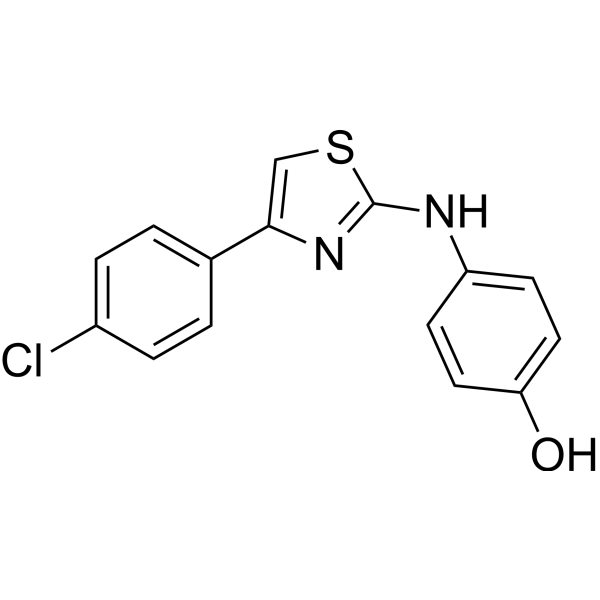 0 ImagesSKI-II is an orally active dual-target inhibitor of SphK1/2 and DES1, with Ki values of 16 µM and 0.3 µM against SphK1 and DES1, respectively. SKI-II activates the PERK-Nrf2 antioxidant pathway by stabilizing Nrf2, and synergizes with Temozolomide (HY-17364) to induce oxidative/endoplasmic reticulum stress and cancer cell death under hypoxic conditions. In vivo, SKI-II inhibits SphK activity, promotes ceramide accumulation and apoptosis, and synergizes with Cisplatin (HY-17394) to reverse drug resistance via the ras/MAPK pathway. SKI-II reduces measles virus replication by inhibiting mTORC1 activity. SKI-II binds to VCP to induce M1 polarization, enhances host tolerance to Staphylococcus aureus infection, and exerts radioprotective effects through Nrf2 activation and accelerated DNA repair. SKI-II can be used in research related to glioblastoma, acute myeloid leukemia, gastric cancer, measles virus infection, Staphylococcus aureus infection, and acute radiation syndrome.
-
XM462
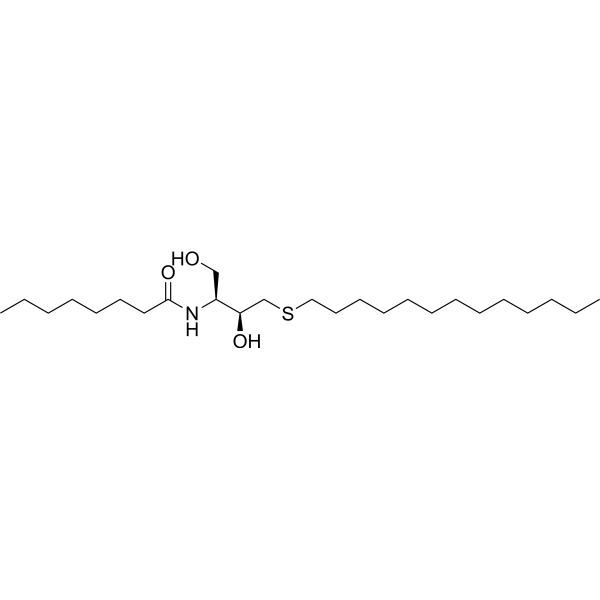 0 ImagesXM462 is a dihydroceramide desaturase inhibitor. XM462 produced a mixed-type inhibition (Ki=2 μM) in vitro. XM462 has dihydroceramide desaturase inhibition both in vitro and in cultured cells with IC50 values of 8.2 and 0.78 μM, respectively. XM462 can be used for the research of tumor.
-
(1R,2S)-Deoxy-PR280
 0 ImagesCat. No.: HY-W673679CAS No.: 649767-83-9(1R,2S)-Deoxy-PR280 is a competitive inhibitor of dihydroceramide desaturase, with a Ki of 6 µM.
-
PR280
 0 ImagesCat. No.: HY-163472Purity: 98.69%PR280 is a dihydroceramide desaturase 1 (Des1) inhibitor with an IC50 of 700 nM. PR280 is used for the research of metabolic diseases, cancers, and neurodegenerative diseases.
-
GAA-4OH
 0 ImagesCat. No.: HY-183723GAA-4OH is a potent and irreversible dihydroceramide desaturase-1 (DES1) inhibitor with an IC50 of 0.6 μM and a Ki of 139.5 nM. GAA-4OH undergoes oxidation to form a reactive iminoquinone that covalently blocks DES1’s catalytic cavity, causing permanent enzyme inactivation. GAA-4OH modulates sphingolipid balance by reducing ceramide-to-dihydroceramide ratios in liver tissue. GAA-4OH improves liver steatosis, inflammation, fibrosis, and reduces pro-inflammatory and pro-fibrogenic gene expression. GAA-4OH can be used for the research of metabolic dysfunction-associated steatotic liver disease (MASLD).
-
SKI II hydrochloride
 0 ImagesCat. No.: HY-112364CAS No.: 1177741-83-1SKI-II hydrochloride is an orally active dual-target inhibitor of SphK1/2 and DES1, with Ki values of 16 µM and 0.3 µM against SphK1 and DES1, respectively. SKI-II hydrochloride activates the PERK-Nrf2 antioxidant pathway by stabilizing Nrf2, and synergizes with Temozolomide (HY-17364) to induce oxidative/endoplasmic reticulum stress and cancer cell death under hypoxic conditions. SKI-II hydrochloride inhibits SphK activity, promotes ceramide accumulation and apoptosis, and synergizes with Cisplatin (HY-17394) to reverse drug resistance via the ras/MAPK pathway in vivo. SKI-II hydrochloride reduces measles virus replication by inhibiting mTORC1 activity. SKI-II hydrochloride binds to VCP to induce M1 polarization, enhances host tolerance to Staphylococcus aureus infection, and exerts radioprotective effects through Nrf2 activation and accelerated DNA repair. SKI-II hydrochloride can be used in research related to glioblastoma, acute myeloid leukemia, gastric cancer, measles virus infection, Staphylococcus aureus infection, and acute radiation syndrome.



